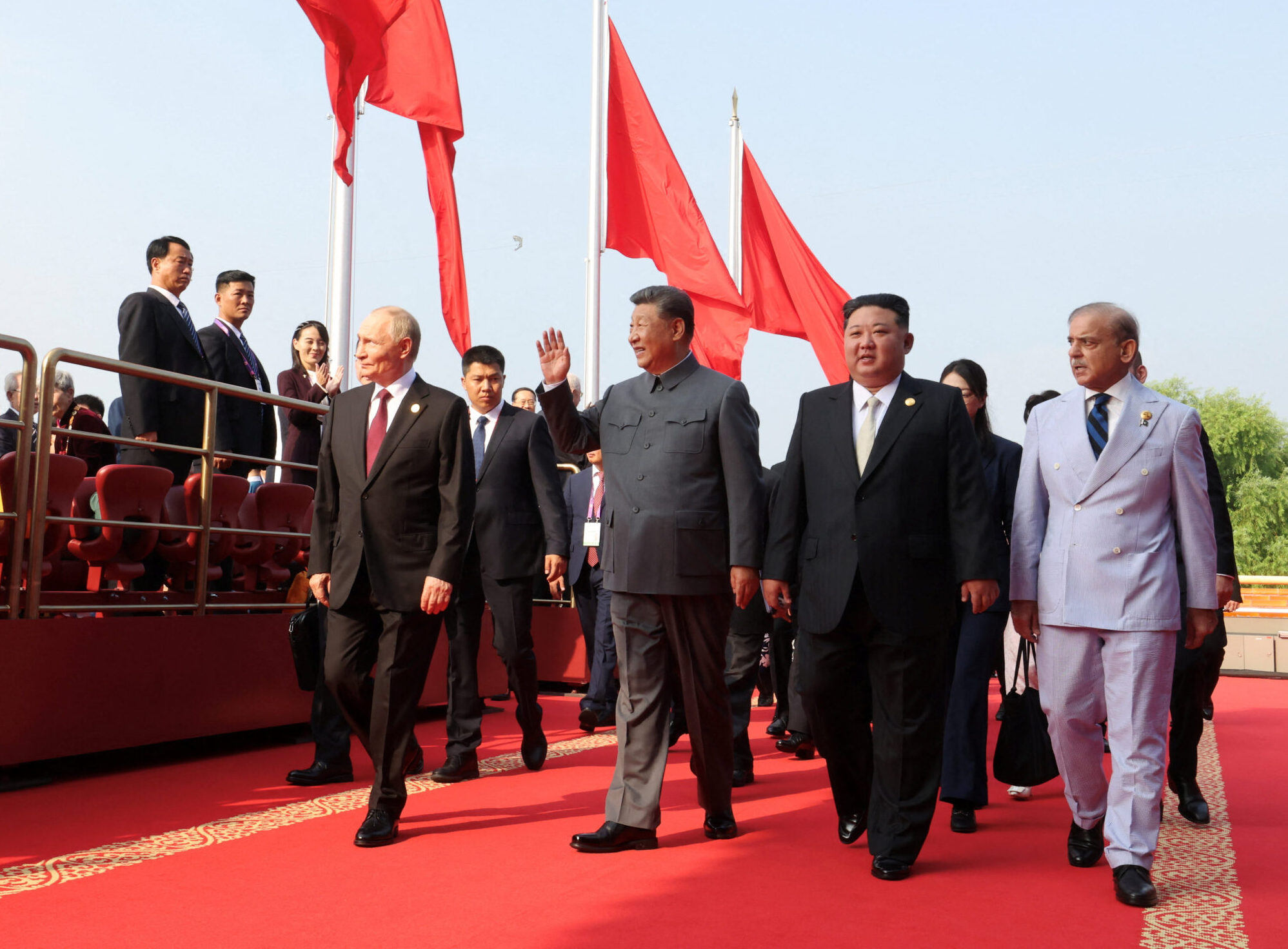
Russian President Vladimir Putin, Chinese President Xi Jinping, North Korean leader Kim Jong Un and Pakistan's Prime Minister Shehbaz Sharif arrive at the Tiananmen Gate for a military parade marking the 80th anniversary of the end of World War Two, in Beijing, China September 3, 2025. cnsphoto via REUTERS ATTENTION EDITORS - THIS IMAGE WAS PROVIDED BY A THIRD PARTY. CHINA OUT.
The Concept of the “New World Order” in Politics: Origins, Interpretations, and Impact
The term “New World Order” (NWO) has evolved from an aspirational geopolitical vision into a multifaceted political concept, encompassing elements of international governance, global power shifts, and in some interpretations, conspiracy theory. From the postwar efforts at building collective peace frameworks to modern-day concerns about rising authoritarianism and multipolar global dynamics, this concept remains highly relevant to understanding the undercurrents shaping the world today.
In this article, we trace the historical trajectory of the New World Order, analyse its symbolic and practical meanings, and explore its real-world relevance and implications for the United Kingdom and the world more broadly.
Origins and Definitions: What Is the “New World Order”?
The phrase “New World Order” has been used throughout the 20th century and into the 21st to refer to pivotal realignments in the global political and economic systems. It generally describes epochs where geopolitical, ideological, or economic shifts lead to new forms of governance or international collaboration. While sometimes adopted by political leaders to frame changes in global strategy, it equally exists as a buzzword in sceptical discourses, ranging from cautious policy critiques to elaborate conspiracy theories.
From a formal political standpoint, the New World Order implies a redefined world governance style, often following major wars, widespread economic disruption, or technological revolutions. Typically, such suggestions involve either the reinforcement or rethinking of global institutions such as the United Nations, NATO, or the World Bank to better reflect current global realities.
How the Concept Developed Over Time
The evolution of the New World Order concept has mirrored global transformations from empires to nation-states, Cold War dynamics, and modern globalisation. The term does not denote a fixed system or doctrine but a set of aspirations or strategic trends often advocated by major powers during or after geopolitical disruption.
Notable Historical Milestones and Promoters of the Concept
Let’s examine some of the key political figures and contexts in which the term “New World Order” was applied and discussed:
| Period | Figure / Context | Contribution / Interpretation |
|---|---|---|
| Post-World War I (1919) | Woodrow Wilson | Coined the phrase in connection with the League of Nations, proposing a peaceful international order based on diplomacy and collective security. |
| Late 1980s | Mikhail Gorbachev | Advanced the concept by advocating for nuclear disarmament, strengthened role for the UN, reduced military alliances, and redirected resources towards domestic needs. |
| Early 1990s | George H.W. Bush | Promoted the idea during the Gulf War as a U.S.-led order fostering non-interventionism, political liberty, and global cooperation. |
Each of these formulations reflected broader hopes for systemic peace, economic cooperation, or ideological harmony. However, they also triggered criticisms for reflecting the interests of dominant world powers, particularly the United States, and for being overly idealistic or neo-imperialist.
The Post–Cold War Global Order
Following the Cold War’s conclusion, the theoretical and practical frameworks supporting the idea of a New World Order experienced major reconfigurations. The conversion of military alliances into vehicles of political influence, increased emphasis on trade liberalisation, and digital-era global interconnection all created conditions that fuelled both optimism and scepticism.
The United States’ assumed leadership in projecting liberal democracy and capitalism—sometimes through military intervention—became defining characteristics of the international system:
- The post-Cold War era saw Washington expanding institutions like NATO while leading interventions in Kosovo, Iraq, and Afghanistan (you can read more about the role of media narratives and misinformation in complex geopolitical issues such as Kosovo here: https://www.mypoliticalhub.com/uncategorized/cnn-politics-denmark-kosovo/).
- The economic side of this order favoured rules-based international trade, contributing to World Trade Organization reforms and financial deregulation.
- Democracy promotion emerged as a diplomatic tool but faced geopolitical pushback and accusations of undermining sovereignty.
For the UK, participating in this system aligned with the “special relationship” with the United States, as well as broader integration into EU security and development mechanisms (at least until Brexit began reshaping these terms).
Contemporary Dynamics: Multipolarity and Global South Influence
As confidence in liberal globalism has waned due to financial crises, long wars, and nationalist backlashes, a fragmented or evolving global order has taken centre stage. Scholars identify trends such as:
- The rise of China as a strategic rival with economic influence in Asia, Africa, and South America, affecting political developments not just globally but also on regional levels, as seen in various countries including Nigeria, whose governance model can reflect the wider changes in global power dynamics discussed here: https://www.mypoliticalhub.com/2026/01/01/kano-politics-electoral-system/
- Russian regional militarism (e.g., Crimea, Ukraine) challenging the assumptions of sovereignty.
- Technological convergence eroding traditional borders and giving rise to cyber threats, surveillance concerns, and digitally mediated authoritarianism.
- A decline in Western predominance, where states in the Global South increasingly forge multi-vector foreign policies rather than choosing between U.S. and Chinese blocs.
Tony Blair noted in 2022 that the 21st century could shift toward bipolar or multipolar competition where the West no longer sets global norms alone. The UK must reconcile its foreign policy aims—like the Indo-Pacific tilt or humanitarian diplomacy—with strategies adaptable to regional power centres and divided global rules.
Conspiracy Theories Around the “New World Order”
Beyond formal political usage, the term “New World Order” is infamously prominent in conspiratorial interpretations. These theories generally assert that a covert cabal—often involving political elites, financial institutions, or ideological groups—is orchestrating global events to reduce public freedoms and install a totalitarian global regime.
Features of NWO conspiracy narratives include:
- Claims of manipulated global pandemics, wars, and financial crises.
- Suspicions targeted at the UN, World Bank, IMF, Bilderberg Group, or multinational corporations.
- The belief in an imminent loss of national sovereignty, democracy, and religious freedoms.
- The portrayal of international crises as “planned” means to encourage society to accept authoritarian solutions.
These views often converge with wider disinformation trends, and in the UK, they gained traction amid Brexit debates, COVID-19 measures, and populist political rhetoric, sometimes linked to far-right or ultra-libertarian groups. The UK’s counter-terrorism policing, through bodies like the Centre for the Protection of National Infrastructure (CPNI) and Counter Disinformation Units, has flagged such conspiracy-driven extremism as a legitimate security concern.
This reflects concerns similar to those associated with reactionary political discourse amplified by polarising public figures—covered in profiles such as Scott Adams and others who shape modern information landscapes: https://www.mypoliticalhub.com/uncategorized/who-is-scott-adams-politics/
Who Is Affected by the Realities and Rhetoric of the New World Order?
The impact of the New World Order—both in terms of actual institutional reforms and imagined plots—touches governments, international organisations, citizens, and non-state actors:
- Governments must navigate foreign policy recalibrations amid multipolarity, especially the UK post-Brexit as it develops new transatlantic and Indo-Pacific partnerships.
- Supranational Bodies such as the UN, IMF, and NATO deal with legitimacy challenges, mission creep, and claims of partiality or dysfunction under the New World Order lens.
- Media and civil society play pivotal roles in either validating multilateral reforms or challenging them through alternative narratives. This includes increased public pressure to sift through credible reporting and counter disinformation, especially in a digital age where content like fabricated news graphics—as highlighted in this example: https://www.mypoliticalhub.com/uncategorized/cnn-politics-denmark-kosovo/—can rapidly influence opinion.
- Ordinary citizens encounter the impact through shifting trade agreements, military engagements, media discourse, or public health policy—all sometimes framed in NWO conspiracist language.
Practices, Risks, and Policy Recommendations in the UK Context
Recognising the dual nature of the term—as a real-world framework and as a vessel for misinformation—is key in effective public policy and academic discourse. Several recommendations emerge to protect democratic integrity while repositioning the UK within evolving world dynamics:
Policy Recommendations and Precautions Regarding the New World Order
| Focus Area | Action Steps | UK Examples / Bodies |
|---|---|---|
| Public Communication | Promote transparency about international agreements or military deployments to prevent misinformation. | FCDO communication strategies, parliamentary debates. |
| Disinformation Resilience | Educate the public via schools and media on critical thinking and information validation. Teaching about how legal frameworks like the Insurrection Act are interpreted in real versus conspiratorial usages can also support this cause: https://www.mypoliticalhub.com/uncategorized/what-is-the-insurrection-act-in-politics/ | DCMS Counter Disinformation Unit, Ofcom regulation campaigns. |
| Foreign Policy Flexibility | Develop regional partnerships while maintaining global commitments. | Global Britain initiative, security accords with Australia and Japan. |
| Academic and Media Discourse | Ensure terms like “New World Order” are critically analysed and contextualised. | BBC fact-check programming, university geopolitical analysis hubs. |
These approaches aim to clarify public understanding while strengthening democratic participation in policymaking around ever-changing global norms.
The “New World Order” remains a fluid and contested concept. In its aspirational political form, it reflects the universal but fraught goal of peaceful, rules-based international cooperation, especially in the wake of global trauma. However, when adopted unquestioningly or distorted into conspiracy, it can also challenge truth, undermine trust, and destabilise civic life.
Understanding its origins—from Wilson’s League of Nations to post-Cold War deterrence and modern multipolarity—is crucial for any global citizen today. The UK, in particular, must navigate this ideological terrain carefully. By combining robust foreign policy with national debate, digital literacy, and critical education, it can play a part in forging a reality-based and inclusive approach to global governance.
Whether you regard it as a diplomatic doctrine, policy framework, or problematic buzzword, the “New World Order” demands scrutiny, context, and clarity. Safeguarding truth, national independence, and democratic integrity amidst global flux is not just a matter of avoiding conspiracy—it’s a central responsibility for modern states and societies alike.
About The Author