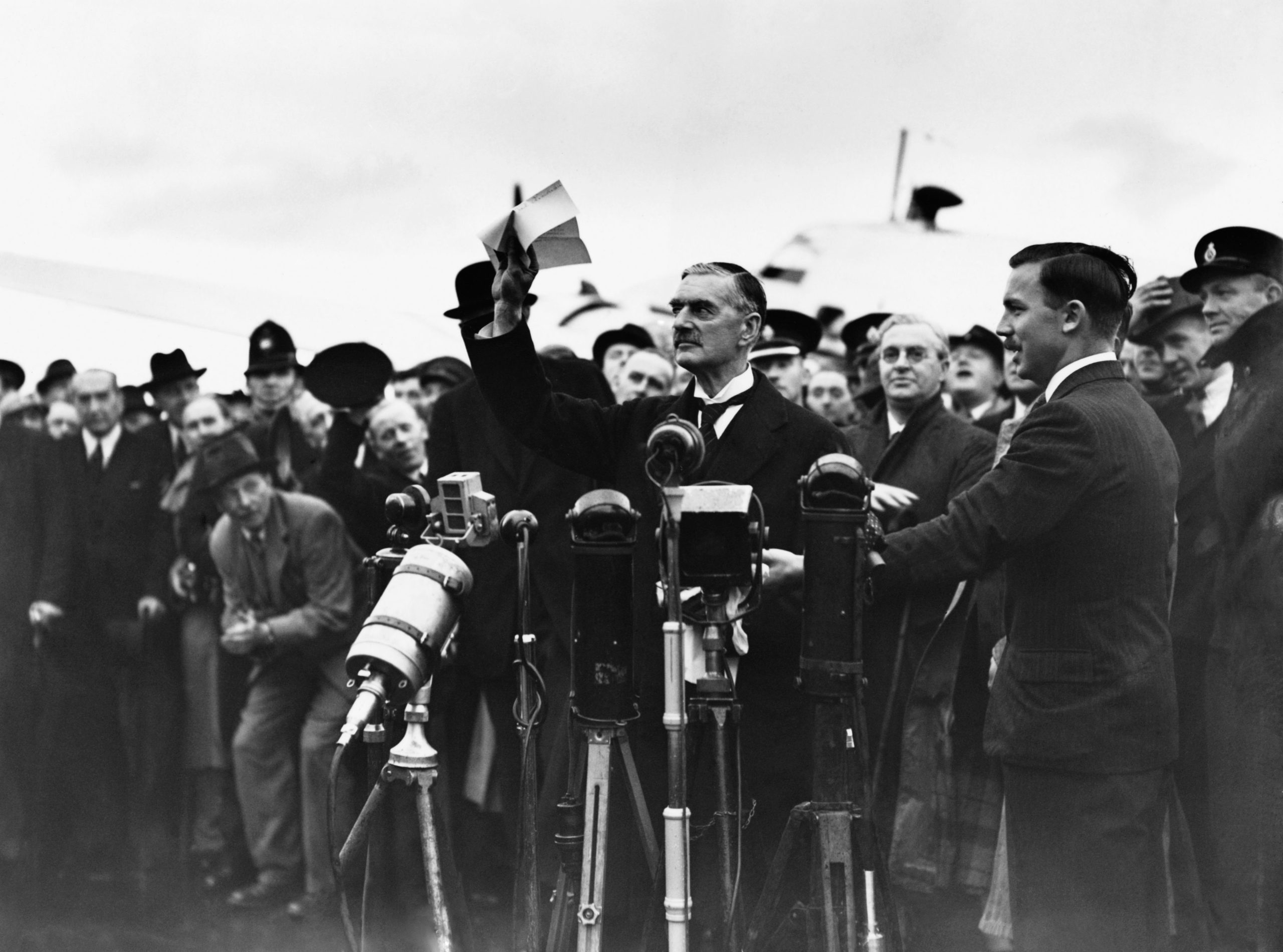
Prime Minister Neville Chamberlain waves to the crowd at Heston Airport and declaims, "Peace in our Time", after returning from signing the Munich Agreement. (Photo by © Hulton-Deutsch Collection/CORBIS/Corbis via Getty Images)
Neville Chamberlain: Overview
Neville Chamberlain (1869–1940) was a British Conservative politician who served as Prime Minister from May 1937 to May 1940. He is primarily known for his foreign policy of appeasement toward Nazi Germany, aimed at avoiding another world war through concessions to Adolf Hitler – European foreign policy of the Chamberlain ministry – How Britain hoped to avoid war with Germany in the 1930s – Neville Chamberlain.
Definitions
- Appeasement: A diplomatic strategy of making concessions to an aggressive power to prevent conflict. In the 1930s, it involved Britain (under Chamberlain and predecessors) allowing Germany to expand territory, such as remilitarizing the Rhineland (1936) and annexing Austria (Anschluss, 1938), to address perceived grievances from the Treaty of Versailles – How Britain hoped to avoid war with Germany in the 1930s – Neville Chamberlain.
- Chamberlain’s approach stemmed from a belief that dictatorships arose from legitimate grievances, which could be resolved diplomatically rather than militarily – European foreign policy of the Chamberlain ministry.
Legal Framework (UK)
No specific modern UK statutes directly govern “Chamberlain” as a policy term, as it refers to a historical strategy rather than ongoing legislation. During Chamberlain’s era:
- UK foreign policy operated under the royal prerogative, with parliamentary oversight via addresses and debates (e.g., Winston Churchill’s 1938 Commons speech condemning the Munich Agreement as a “total and unmitigated defeat”) – Neville Chamberlain.
- Post-1939, Parliament passed laws like general conscription on 3 September 1939, following declarations of war on Germany – Neville Chamberlain.
Contemporary UK international law frameworks (e.g., UN Charter, post-WWII) emphasize collective security over unilateral appeasement, but no direct “anti-appeasement” laws exist; policy is shaped by the Foreign, Commonwealth & Development Office (FCDO).
Responsible Authorities
- Historical: Chamberlain as Prime Minister (1937–1940), with input from the Cabinet, Chiefs of Staff, and diplomats. Key events involved negotiations with France and direct meetings with Hitler – European foreign policy of the Chamberlain ministry – How Britain hoped to avoid war with Germany in the 1930s – Chamberlain and Hitler.
- Current (UK): The FCDO leads foreign policy formulation. Parliament scrutinizes via select committees (e.g., Foreign Affairs Committee). No dedicated “appeasement oversight” body, as the term is historical – Chamberlain and Hitler.
Current Rules
Appeasement is not a codified “rule” in modern UK policy but is widely discredited as a weakness that emboldened aggressors. UK doctrine prioritizes deterrence, alliances (e.g., NATO), and sanctions under frameworks like the UN Charter Article 2(4) prohibiting force. Post-1945, policies emphasize early intervention (e.g., Kosovo 1999, Libya 2011) to avoid Munich-style concessions – How Britain hoped to avoid war with Germany in the 1930s – Neville Chamberlain – Why Neville Chamberlain will forever be discredited by his policy of appeasement.
Recent Changes
No recent legislative changes reference “Chamberlain” or appeasement directly (as of 2026). UK Integrated Review (2021, refreshed 2023) stresses “strategic competition” with autocracies (e.g., Russia, China), rejecting appeasement through increased defense spending (2.5% GDP target by 2030) and AUKUS/NATO commitments. Historical rehabilitation attempts (e.g., 2022 Netflix film based on Robert Harris’s Munich) argue Chamberlain bought rearmament time, but consensus views it as flawed – Why Neville Chamberlain will forever be discredited by his policy of appeasement.
Risks
- Historical Risks Identified: Encouraged Hitler’s further aggression (e.g., Munich Agreement 1938 ceded Sudetenland, enabling Czechoslovakia’s full conquest and use of its arms industry in later invasions) – European foreign policy of the Chamberlain ministry – How Britain hoped to avoid war with Germany in the 1930s – Why Neville Chamberlain will forever be discredited by his policy of appeasement. Britain was economically overstretched, with inadequate forces for global commitments – European foreign policy of the Chamberlain ministry.
- General Risks: Signals weakness, erodes alliances, and allows aggressors to rearm unchecked. Critics like Churchill warned it “deeply compromised” UK security – Neville Chamberlain. Public sympathy for Germany’s Versailles grievances amplified miscalculations – How Britain hoped to avoid war with Germany in the 1930s.
Practical Implications
- Historical Outcomes: Bought ~1 year for RAF rearmament (via “limited liability” doctrine prioritizing air/sea over army), but delayed confrontation until Poland’s invasion (1 September 1939), leading to war declarations (3 September 1939) – European foreign policy of the Chamberlain ministry – Neville Chamberlain – Chamberlain and Hitler. Chamberlain resigned in 1940 amid Norway Debate criticism.
- Lessons for Today: Shapes UK avoidance of unilateral concessions (e.g., Ukraine support post-2022). Emphasizes alliances, intelligence, and rapid response over negotiation alone. Debates persist on “buying time” vs. emboldening foes – Why Neville Chamberlain will forever be discredited by his policy of appeasement – Chamberlain and Hitler.
- Broader: Influenced post-WWII institutions like NATO to prevent repeats; informs current analyses of deterrence vs. diplomacy – How Britain hoped to avoid war with Germany in the 1930s.
About The Author