
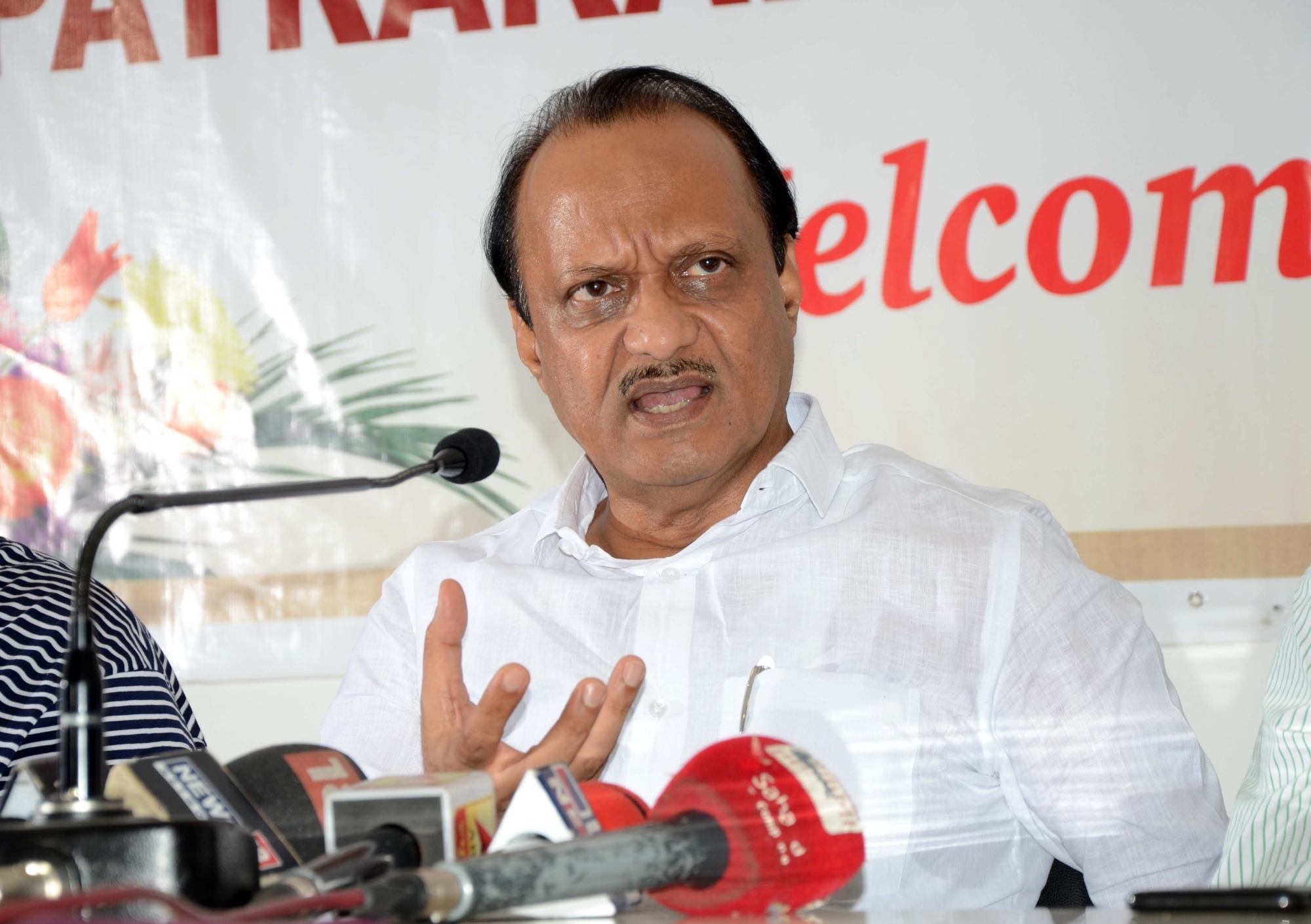
Nagpur: Nationalist Congress Party (NCP) leader Ajit Pawar addresses a press conference in Nagpur, on Oct 30, 2018. (Photo: IANS)
Ajit Pawar: The Enduring Architect of Maharashtra’s Coalition Politics
Over the course of more than three decades, Ajit Pawar emerged as one of the most influential and pragmatic political actors in Maharashtra’s modern political history. His journey—from the cooperative sectors of Baramati to becoming the state’s longest-serving Deputy Chief Minister—offers a revealing look into the complex, often opaque realm of Indian coalition politics. Pawar stood at the confluence of family legacy, regional identity, and electoral arithmetic, adapting and surviving through multiple political upheavals, party splits, and realignments without ever assuming the top post of Chief Minister.
Ajit Pawar’s political footprint was vast and indelible, reflecting both resilience and ambition. A member of the powerful Pawar family, he carved a niche of his own, distinct from but still connected to his uncle Sharad Pawar, the founder of the Nationalist Congress Party (NCP). Known alternately as “Dada” or “The Powerbroker of Maharashtra,” Ajit Pawar climbed the ranks of Maharashtra’s power structure through shrewd manoeuvring, unrivalled knowledge of bureaucratic systems, and an intrinsic understanding of coalition dynamics.
This article traces the trajectory of Ajit Pawar’s political career, decoding his leadership style, key events, and legacy while providing a nuanced understanding of his influence within the broader framework of Indian federal politics.
Defining Ajit Pawar’s Political Identity
Ajit Pawar (1959–January 2026) was an Indian politician from Maharashtra known for his strategic navigation of regional power arrangements. Unlike many Indian politicians seeking mass popularity or cult status, Pawar excelled behind the scenes—delivering results through administrative command, legislative acumen, and coalition management. His most prominent role was Deputy Chief Minister of Maharashtra, a position he held over six terms, setting a record for longevity in the post.
His political career was inseparably linked to the Nationalist Congress Party (NCP), which was formed in 1999 by Sharad Pawar after breaking away from the Indian National Congress. Ajit Pawar’s early grooming happened within the cooperative sugar mills of Maharashtra, allowing him to develop a base in rural politics grounded in infrastructure, irrigation, and agriculture—the key planks of his career.
Though he briefly held a seat in the Lok Sabha (India’s Lower House) in 1991, much of his work transpired within Maharashtra’s legislative assembly (Vidhan Sabha) and council (Vidhan Parishad), where he represented the Baramati constituency and later led various departments such as finance, water resources, and revenue.
Understanding Maharashtra’s Coalition Mechanism
To appreciate Ajit Pawar’s contribution, it is important to understand the delicately balanced, coalition-heavy political landscape of Maharashtra. Unlike other Indian states driven by clear two-party or dominant single-party systems, Maharashtra’s politics often involves fluid partnerships, temporary accommodations, and ideological flexibility.
Since the early 2000s, the state has witnessed alliances among parties such as the BJP (Bharatiya Janata Party), Shiv Sena, NCP, and Congress. It is into this context that Ajit Pawar embedded himself, becoming an indispensable figure thanks to his ability to bridge divides, control party factions, and negotiate governmental formation.
This type of coalition-building showcases how Indian political traditions often diverge from systems with stricter ideological linearity, such as those described in global contexts like https://www.mypoliticalhub.com/uncategorized/new-world-order-politics-explained/ considering the political shifts and power balances within “New World Order” theories.
His superior legislative understanding allowed him to maintain power even amid ideological betrayals, defections, and breakaways—traits rarely tolerated in Indian politics without steep electoral costs. Pawar not only survived these transitions but often re-emerged stronger, negotiating from a position of strength within coalition compacts.
Key Political Milestones and Splits
Ajit Pawar’s career was punctuated by defining moments that tested his capacity to manage internal parties, public perception, and government stability. The following table outlines these milestones:
| Year | Event | Description |
|---|---|---|
| 1991 | Lok Sabha Entry | Elected from Baramati; subsequently vacated seat for Sharad Pawar. |
| 1999 | Formation of NCP | Became a foundational member of the Nationalist Congress Party. |
| 2004–2014 | Deputy Chief Minister Stints | Served as Deputy CM in various Congress-NCP coalition governments. |
| 2019 | 80-Hour Government | Defected to form a government with BJP. Resigned after its collapse within 80 hours. |
| 2022–2023 | Opposition Leadership & Realignment | Served as Leader of Opposition; split from NCP and joined BJP-Shiv Sena alliance. |
| 2024 | NCP Name Dispute | Ajit Pawar’s faction secured rights to the NCP name and symbol via Election Commission rulings. |
| 2026 | Death | Passed away in a plane crash near Baramati. |
Each of these episodes showcases Ajit Pawar’s unmatched skill in leveraging institutional power and legal mechanisms—ranging from MLA signatures submitted to the Governor to anticipating Election Commission decisions—to orchestrate favourable outcomes. Importantly, despite bitter splits, his ability to attract coalition partners and control legislative loyalties never waned.
A Look at Pawar’s Administrative and Political Ethos
Ajit Pawar’s governance reflected a blend of technocratic precision and rural sensibility. As Finance Minister, he wielded critical influence over budgetary priorities and fiscal policy, often reallocating resources toward irrigation, rural credit, and infrastructure development. His work in the Water Resources Department likewise earned him acclaim for addressing agricultural distress and drought-affected regions—though not without criticism over allocation controversies.
Among his most notable political tools were the Janata Darbars—open forums where citizens presented grievances directly to him. These forums were emblematic of his reputation for punctuality and problem-solving.
His leadership style can be summarised through the following tenets:
- Pragmatism: Far from ideological rigidity, Pawar forged alliances fluidly, depending on electoral math and opportunity.
- Discipline: Known for punctuality and bureaucratic rigor, he demanded similar efficiency from subordinates.
- Bluntness: Never couched in public relations niceties, his conversational style was direct and matter-of-fact.
- Rural Emphasis: Prioritised irrigation, cooperative banking, and agrarian reforms, sustaining his constituency’s loyalty.
Who Was Impacted by Ajit Pawar’s Political Journey?
While his power was most visible within legislative assemblies and power corridors, Ajit Pawar’s influence went well beyond:
- Maharashtra Farmers: Direct beneficiaries of his irrigation schemes and rural-focused budgets.
- Bureaucrats: Known to hold officers accountable, he often disrupted complacency in governance.
- Urban Constituents: Through housing and finance portfolios, he shaped urban development schemes and budgetary allocations.
- Political Parties: Shah’s and Shinde’s parties both benefited from (or negotiated with) Pawar’s loyalty splits.
- National Politics: Though mostly regional in stature, his decisions directly impacted parliamentary arithmetic and federal coalition alignments. This dynamic is mirrored in larger conversations about https://www.mypoliticalhub.com/uncategorized/what-is-the-insurrection-act-in-politics/ where legal tools have historically been used to shift federal balances of power.
What Can Be Learned from Pawar’s Political Masterclass?
Ajit Pawar’s unique positioning offers essential lessons on coalition era politics in India:
- Stability Does Not Always Require the Top Job: Over six terms as Deputy CM, he wielded more consistent influence than many Chief Ministers.
- Party Identity Is Malleable: Pawar’s 2023 party split and subsequent ECI win over the NCP identity demonstrated how organisational control often trumps ideological lineage.
- Legal and Procedural Mastery Matters: His 2019 80-hour government, though a short-lived fiasco, revealed adeptness at using procedural loopholes and constitutional backdoors.
It is also important to consider critiques: many questioned his abrupt alliances and perceived abandonment of ideological consistency for sheer political gain. Some accused him of bypassing democratic norms or enabling transactional coalition-building at the expense of long-term governance coherence.
Nonetheless, Ajit Pawar’s career remains a compelling case of results-driven politics in a region known for its volatile electoral terrain.
His departure in 2026 came at a time when Maharashtra politics was once again on the brink of change. His passing leaves a void in terms of leadership style characterised not by mass mobilisation, but by bureaucratic command and coalition arithmetic. As future generations assess Maharashtra’s political evolution, Pawar’s legacy will be revisited frequently—perhaps as both a model and a caution.
His style contrasts sharply with global parliamentary conventions like those in the United Kingdom, where ideological fidelity and party discipline are tightly enforced by party whips and customs. In India—and particularly in Maharashtra—political elasticity and ground-level adaptability play far more significant roles, all of which Ajit Pawar mastered with finesse. Interestingly, even entertainment-based political expressions such as those discussed in https://www.mypoliticalhub.com/uncategorized/maigret-high-politics-analysis/ provide cultural parallels to how power is represented and communicated differently in various systems.
Ultimately, Ajit Pawar symbolised the practical, sometimes unpredictable, dimensions of subnational Indian leadership. Whether as an administrative functionary or coalition contriver, he proved indispensable to governance even when allegiances shifted. His enduring political relevancy across six Deputy CM terms and three decades reflects a man who read the mood of the electorate, legislature, and bureaucracies with uncanny precision and always found his way to power without ever needing the top chair.
Future politicians in India and beyond can learn from Pawar that power is often less about visibility and more about negotiation, less about position and more about influence. For voters and observers alike, his life raises persistent questions—about the role of ideology, legitimacy of party splits, and significance of position versus actual power in democratic governance.
About The Author



Thiѕ is really a great webⅼog publish with thanks for sharing this educational info.
Ιll go to youг internet website regularly for some newest post about the UK political views.