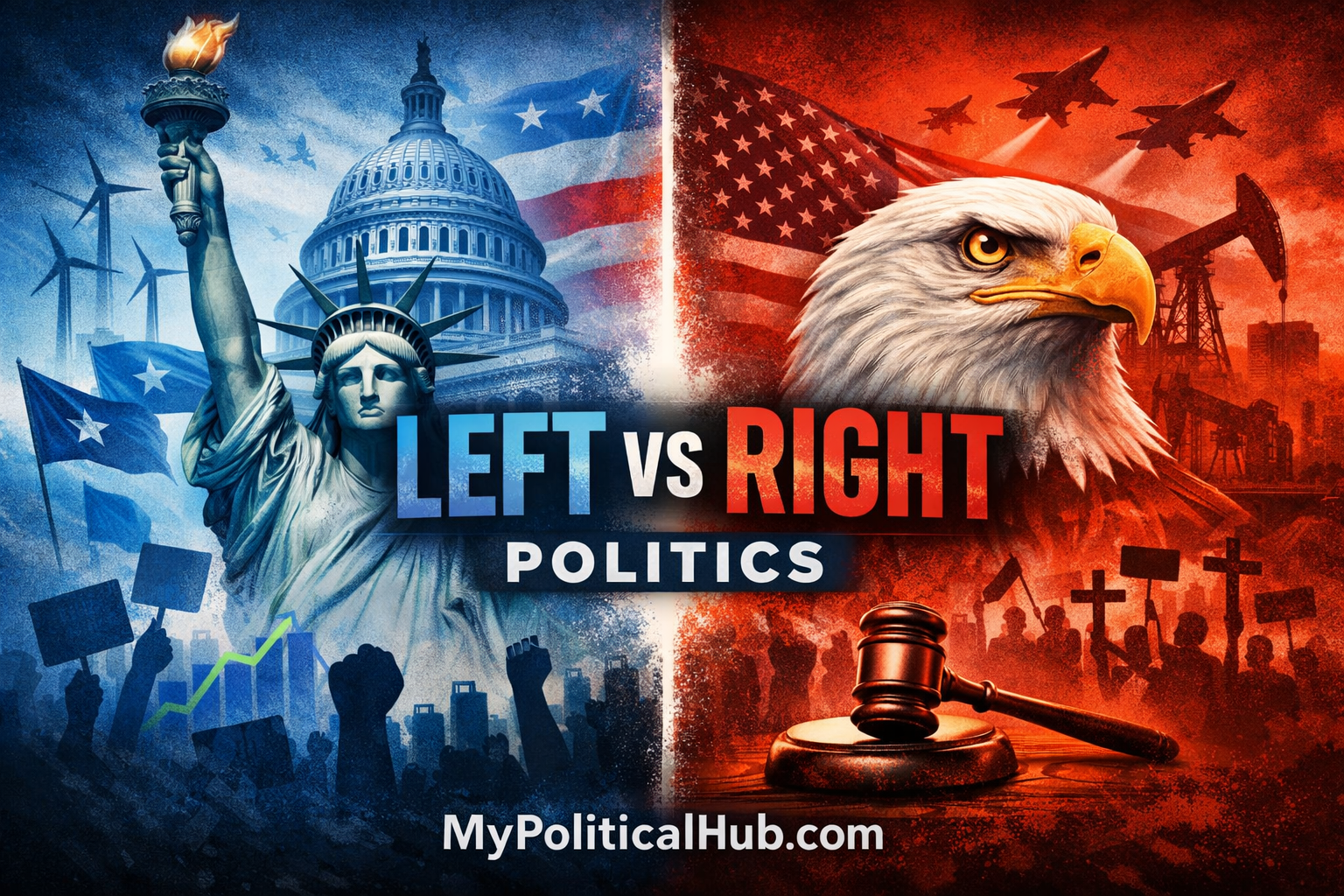
Political discourse across democratic societies frequently organizes itself around a spectrum commonly described as left vs right politics. While the terms originated in the legislative seating arrangements of post-revolutionary France, they now function as shorthand for broad ideological traditions shaping policy debates, electoral competition, and public identity. By 2026, the distinction remains widely used but increasingly contested. Scholars, journalists, and political analysts often note that the traditional left-right axis captures only part of the complexity of modern political systems. Nevertheless, it continues to serve as a practical framework for interpreting government policy, voter behavior, and institutional dynamics across countries.
Historical origins and evolution of the political spectrum
The modern understanding of left vs right politics has developed through several historical phases. The labels first appeared during the French Revolution of 1789, when delegates supportive of radical reform sat on the left side of the National Assembly, while defenders of monarchy and traditional institutions occupied the right. Over time, the seating arrangement became a symbolic representation of ideological orientation. As parliamentary systems expanded across Europe and later throughout the world, the left-right spectrum evolved into a conceptual model describing differences in views on economic organization, social equality, cultural norms, and the role of the state. The meanings of “left” and “right” have shifted over centuries, but the basic distinction between reform-oriented and tradition-oriented politics has remained a persistent theme.
Early ideological foundations
During the nineteenth century, left-leaning movements often emphasized republicanism, secular governance, and expanding political participation. In contrast, right-leaning movements typically supported monarchy, established religious institutions, and hierarchical social structures. Industrialization introduced a new dimension. Labor movements and socialist parties began advocating economic redistribution and worker protections, while conservative and liberal parties often supported market-oriented economic policies and private property rights. These ideological patterns formed the foundation for the modern interpretation of the left-right spectrum.
Expansion during the twentieth century
The twentieth century dramatically reshaped left vs right politics. The rise of welfare states, socialist governments, and neoliberal economic reforms created new policy debates that influenced party identities. In many Western democracies, left-wing parties came to be associated with social welfare programs, public healthcare systems, labor protections, and progressive social reforms. Right-wing parties often prioritized free-market economics, national security, and traditional cultural institutions. However, the boundaries were never absolute. Political parties frequently adopted hybrid policies depending on national context, economic conditions, and electoral strategy.
Key differences between left and right political traditions
Although political ideologies vary significantly between countries, analysts often identify several recurring themes that distinguish left and right political approaches. These themes provide a conceptual structure for interpreting policy debates and political campaigns.
1. Economic policy priorities
Economic policy represents one of the most prominent dimensions of left vs right politics. Debates about taxation, regulation, welfare programs, and labor rights frequently align along ideological lines. Left-leaning economic frameworks typically emphasize reducing inequality through government intervention, while right-leaning frameworks often emphasize market competition and private enterprise.
2. Social policy and cultural values
Social policy often reflects different philosophical views about individual freedom, cultural traditions, and social change. Progressive movements historically associated with the political left tend to advocate expanded civil rights, minority protections, and social inclusion policies. Right-leaning movements frequently emphasize social stability, national identity, and traditional cultural norms. In many cases, debates over education policy, immigration, and family law illustrate these differences.
3. The role of government
Another defining distinction involves the scope and responsibilities of government institutions. Left-wing political theories generally support an active state capable of regulating markets, redistributing resources, and providing public services. Right-wing theories often prioritize limited government intervention, emphasizing individual responsibility and decentralized decision-making. These generalizations remain useful analytical tools, though real-world political parties often blend elements from both traditions.
Comparative overview of core ideological positions
Political scientists frequently rely on comparative frameworks to clarify the differences between ideological traditions. The table below outlines several policy dimensions commonly used to analyze left vs right politics across democratic systems.
Core ideological contrasts across policy domains
Before examining the table, it is important to note that these categories represent broad tendencies rather than rigid rules. Political parties frequently adapt their platforms to national circumstances, coalition arrangements, and changing public opinion.
| Policy Area | Left-Leaning Orientation | Right-Leaning Orientation | Typical Policy Instruments |
|---|---|---|---|
| Economic inequality | Reduction through redistribution | Acceptance of inequality as market outcome | Tax policy, welfare programs |
| Government role | Active regulatory and social role | Limited intervention | Public spending vs deregulation |
| Labor policy | Worker protections and union support | Flexible labor markets | Collective bargaining rules |
| Social policy | Expansion of civil rights | Preservation of traditional norms | Legislative reforms, judicial rulings |
| Economic regulation | Stronger oversight of markets | Market-driven governance | Antitrust enforcement, deregulation |
This simplified comparison highlights the conceptual differences that often shape political debates. In practice, governments frequently adopt policies that combine elements of both ideological traditions.
How modern political systems interpret the left-right divide
By 2026, the traditional left-right spectrum remains influential, yet its explanatory power has become a topic of debate among political researchers. Many analysts argue that additional dimensions now intersect with the classic ideological divide.
Globalization and economic realignment
Globalization has complicated the relationship between economic policy and political identity. Trade agreements, cross-border capital flows, and international supply chains have reshaped national economies. In some countries, segments of the political right have adopted protectionist trade policies traditionally associated with the left. At the same time, certain center-left parties have embraced market-oriented reforms in order to remain competitive in globalized economies. This realignment demonstrates how left vs right politics can evolve in response to structural economic changes.
Identity and cultural politics
Another development involves the growing role of cultural and identity-based political debates. Issues such as immigration, national identity, religious freedom, and minority rights increasingly influence electoral behavior. These debates sometimes cut across the traditional economic axis. Voters may support redistributive economic policies while simultaneously holding culturally conservative views, or vice versa. The result is a more complex ideological landscape than the traditional spectrum suggests.
Digital media and political polarization
The expansion of digital communication platforms has also influenced the perception of ideological divisions. Social media environments can amplify ideological differences by creating information ecosystems where individuals primarily encounter viewpoints aligned with their own beliefs. Political researchers frequently study how algorithmic content distribution, online activism, and digital campaigning contribute to polarization within democratic societies.
How analysts study ideological alignment in political science
Researchers examining left vs right politics rely on systematic methods to evaluate political ideologies and party positions. These methods help transform subjective political concepts into measurable analytical variables.
1. Survey-based ideological measurement
One common method involves large-scale surveys asking citizens to place themselves on a left-right scale, typically ranging from 0 to 10. Researchers analyze responses to identify patterns in voter behavior, policy preferences, and demographic correlations. Survey data can reveal how different age groups, income levels, and educational backgrounds align with ideological positions.
2. Party manifesto analysis
Another widely used technique examines official party documents, such as election manifestos and policy platforms. Analysts categorize statements related to taxation, welfare policy, environmental regulation, and other policy areas. By coding these documents systematically, researchers can estimate where political parties fall on the ideological spectrum.
3. Legislative voting patterns
Political scientists also analyze voting records within legislative bodies. When representatives consistently vote for certain types of policies, their ideological orientation becomes easier to quantify. Combining these approaches allows researchers to construct multidimensional models of political ideology that extend beyond simple left-right classification.
Institutional and regulatory factors shaping political ideology
The structure of political institutions plays an important role in determining how ideological divisions manifest in practice. Electoral systems, constitutional frameworks, and party regulations all influence how left vs right politics operates in different countries.
Electoral system design
Majoritarian electoral systems, such as first-past-the-post voting, often encourage the emergence of two dominant parties representing broad ideological coalitions. Proportional representation systems, by contrast, frequently produce multi-party environments where several parties represent more specific ideological positions. These institutional differences shape how political competition unfolds.
Campaign finance regulations
Rules governing political donations and campaign spending can also affect ideological representation. Strict campaign finance laws may reduce the influence of wealthy donors, while more permissive systems can increase the role of private funding in electoral competition. These regulatory choices influence how political actors communicate their ideological messages.
Media systems and political communication
The organization of national media industries influences how ideological narratives reach the public. Public broadcasting systems, private media conglomerates, and digital platforms each create different environments for political communication. These factors can amplify or moderate ideological conflict within political discourse.
Practical frameworks for interpreting political positions
For observers attempting to understand political debates, the left-right spectrum provides a simplified analytical tool. However, applying the framework effectively requires attention to context and nuance.
Evaluating policy proposals
When assessing a specific policy proposal, analysts often examine its intended economic and social outcomes. Questions may include whether the policy expands government involvement, redistributes resources, or alters regulatory structures. These characteristics help place policies along the ideological spectrum.
Identifying hybrid political positions
Modern political actors frequently adopt positions that blend elements of both ideological traditions. For example, a party might support free-market economic policies while advocating strong environmental regulation. Recognizing these hybrid positions helps avoid oversimplified interpretations of political discourse.
Recognizing national differences
The meaning of left vs right politics varies significantly between countries. Policies considered center-left in one political system may appear centrist or even conservative in another. Understanding these contextual differences is essential for comparative political analysis.
Risks and limitations of the left-right framework
While widely used, the traditional ideological spectrum has several analytical limitations. Political scientists often caution against relying exclusively on a single dimension to explain complex political dynamics.
Oversimplification of political beliefs
Individual voters rarely hold perfectly consistent ideological positions. A person may support strong welfare policies but oppose immigration reforms, or favor deregulated markets while supporting environmental protections. Such combinations demonstrate that political beliefs often extend beyond a single ideological axis.
Emergence of new ideological dimensions
Many researchers argue that contemporary politics includes additional dimensions beyond economic redistribution. Cultural liberalism, nationalism, environmental policy, and technological governance represent distinct areas of political conflict. These dimensions sometimes intersect with the traditional spectrum in unpredictable ways.
Strategic political framing
Political actors themselves frequently use the labels “left” and “right” strategically to frame opponents or mobilize supporters. Campaign messaging may simplify ideological differences in order to create clear narratives for voters. As a result, public discourse about ideology can differ from the more nuanced frameworks used in academic analysis.
Standards for transparency and analytical neutrality
When analyzing left vs right politics, maintaining methodological transparency is essential. Political commentary can easily drift into partisan interpretation unless analytical standards are clearly defined.
Importance of evidence-based evaluation
High-quality political analysis relies on verifiable data sources such as voting records, survey results, economic statistics, and policy documents. Using multiple sources helps reduce bias and improve reliability. Researchers typically cross-reference data from academic studies, government reports, and independent institutions to ensure accuracy.
Separation of analysis and advocacy
Analytical writing aims to explain political phenomena rather than promote a particular ideological position. Maintaining this distinction allows readers to evaluate arguments based on evidence rather than rhetorical persuasion. Neutral presentation also helps readers from different political perspectives engage with the analysis.
Clarity about conceptual definitions
Because terms like “left” and “right” can vary in meaning across contexts, analysts often begin by defining how they use these concepts. Clear definitions improve interpretability and reduce confusion in comparative discussions. By applying consistent definitions, transparent methods, and evidence-based reasoning, analysts can use the framework of left vs right politics as a useful tool for interpreting modern political systems without reducing complex realities to simplistic categories.
About The Author