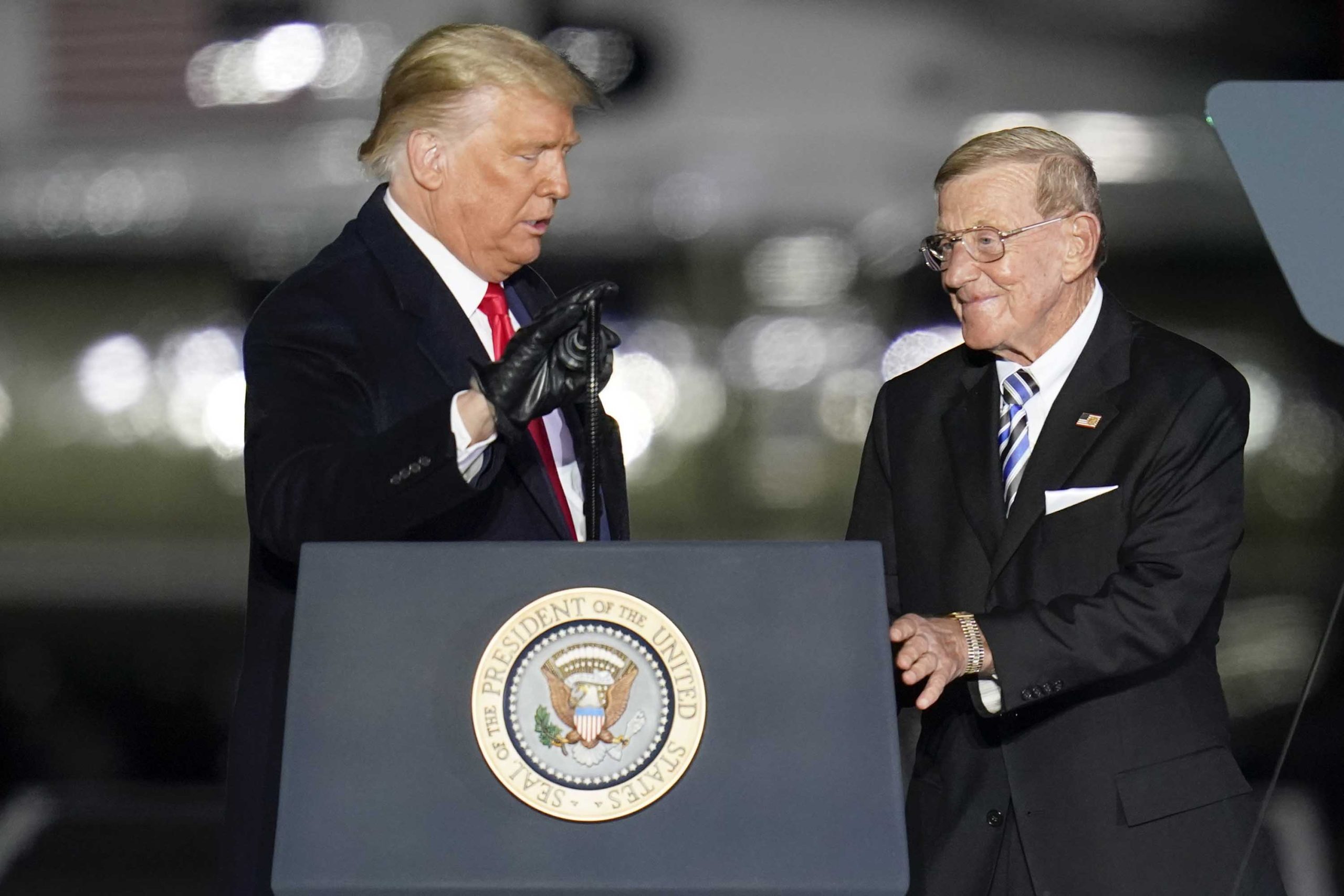
President Donald Trump, left, introduces former college football coach Lou Holtz during a campaign stop, Saturday, Oct. 31, 2020, at the Butler County Regional Airport in Butler, Pa. (AP Photo/Keith Srakocic)
Lou Holtz (1934–2026) remains a significant figure in the intersection of college football and political discourse in the United States. Renowned for leading Notre Dame to a national championship in 1988, Holtz’s contributions to sports are paralleled by his engaging political activities, particularly his vocal support for Donald Trump and the Republican Party from 2016 onward. This article explores Holtz’s life, his coaching achievements, and the political ramifications of his actions, while examining the broader implications of his endeavours in a sports context.
Background on Lou Holtz
Lou Holtz’s journey began on January 6, 1937, in Follansbee, West Virginia. He embarked on a coaching career that would take him through various collegiate football programmes, eventually rising to prominence at the University of Notre Dame. Under his leadership, the Fighting Irish not only won a national championship but also cultivated a legacy of achievement that remains influential today. Holtz is remembered for both his tactical acumen on the field and his character-building approach to coaching.
Coaching Achievements
Holtz’s coaching tenure is marked by several critical milestones, most notably his time at Notre Dame from 1986 to 1996. During this period, he built a formidable team, winning multiple awards and recognition for his work in developing young athletes.
-
National Championship: The apex of Holtz’s coaching career was undoubtedly winning the 1988 national championship, a triumph that solidified his reputation as one of the greats in college football history.
-
Career Highlights:
- Led Notre Dame to an impressive record of 100 victories.
- Received numerous Coach of the Year awards throughout his career.
- Known for fostering strong team cohesion and a culture of excellence.
Political Engagement
Throughout his life, Lou Holtz exhibited a keen interest in politics. His political activities took on a more prominent role from the mid-1980s, particularly as he began aligning himself with conservative ideals. This engagement can be likened to the political insights shared in articles such as Understanding Kano Politics: Key Insights into Governance and Electoral Structures in Nigeria (https://www.mypoliticalhub.com/2026/01/01/kano-politics-electoral-system/), which also explores the complexities of governance.
Early Political Activities
Holtz’s political activism began in earnest during the 1980s when he endorsed Republican candidates, notably Senator Jesse Helms. His support for Helms and his conservative views eventually created tension within his coaching environment at the University of Arkansas, prompting discussions regarding the intersection of personal beliefs in a professional setting.
Endorsement of Donald Trump
Holtz’s support for Donald Trump became particularly pronounced during the 2016 presidential campaign and continued through 2020. His endorsement was characterised by a series of public appearances, speeches, and direct support via social media and political rallies.
RNC 2020 Speech
At the 2020 Republican National Convention, Holtz garnered attention for his speech, where he praised Trump as a “consistent winner” and an “outstanding leader.” His remarks underscored various themes, including:
- Commitment to the unborn, where he specifically critiqued Biden-Harris policies as “radically pro-abortion.”
- Advocacy for traditional family values and support for America.
This speech, while celebrated by some, drew significant criticism for its divisive invocation of Catholicism and its political overtones.
Reactions to Holtz’s Political Stance
Holtz’s increasing political involvement did not come without consequences. His affiliation with partisan issues led to backlash from various stakeholders, including some Notre Dame alumni and players who dissented against his political views, particularly during a time of heightened political division in the United States.
Rebuke from Notre Dame
In light of Holtz’s controversial comments about Joe Biden, the President of Notre Dame, Rev. John I. Jenkins, distanced the university from Holtz’s views. Jenkins voiced concerns about Holtz’s assertions regarding Biden’s Catholic faith, asserting that the university does not endorse any political candidate or ideology.
Contributions to Political Discourse
Holtz’s political involvement extended beyond endorsements. He had a more defined role in advocacy, particularly as the Chair of 1776 at the America First Policy Institute.
Policy Focus
Holtz’s chairmanship involved addressing various key issues pertinent to American governance, such as:
- Civil service reform
- Government regulation
- Election integrity
- Faith and border security
This platform allowed him to influence policies intersecting with his values as a public figure in sports and politics.
Criticism and Backlash
Holtz’s merger of athletics and politics sparked considerable debate, leading to both commendation and critique. This situation echoes sentiments found in discussions about other public figures in political contexts, such as Scott Adams’ controversial journey from Dilbert Creator to Polarizing Commentator (https://www.mypoliticalhub.com/uncategorized/who-is-scott-adams-politics/).
Mixed Reactions from Alumni and Former Players
The blending of his roles as a coach and a political supporter often led to polarized responses. Some former players and alumni expressed discomfort with his political views, suggesting that he leveraged his Notre Dame affiliation in ways that some deemed inappropriate.
Specific Instances of Criticism
Several factors contributed to the backlash against Holtz:
-
RNC Remarks: Many criticized his 2020 RNC speech as exploitative of religious sentiment for political purposes. Critics voiced that such comments were polarizing, especially given the university’s diverse beliefs.
-
Historical Endorsements: His earlier political endorsements were often scrutinized in conjunction with controversies during his coaching career. Although these issues did not result in formal consequences, they added complexity to his public persona.
Understanding Legal Frameworks
While Holtz’s activities had significant impacts within the American political landscape, it is essential to place them within the context of relevant legal frameworks. However, it is pertinent to note that the specifics of his political activities do not intersect with UK laws.
UK Political Framework Relativity
Despite examining Holtz’s engagements and the potential for discourse around political speech, UK laws regarding political participation or expression do not apply to Holtz, primarily due to his status as a U.S. citizen.
-
Human Rights Act 1998: This act protects the right to free expression under the European Convention on Human Rights. However, no legal implications pertained to Holtz’s actions.
-
Political Parties, Elections and Referendums Act 2000: Similarly, legislation pertinent to the UK political landscape holds no relevance to Holtz’s contributions or speech, thereby reflecting the limitations of UK frameworks in defining or critiquing his political activities.
Summary of UK Legal Exclusions
Holtz’s political events, speeches, and endorsements were exclusively American and did not engage UK political discourse. The lack of any UK legal repercussions or involvement facilitates a clearer focus on Holtz’s impact within the United States alone.
Conclusion and Recommendations
Lou Holtz’s multifaceted legacy encompasses both sports excellence and robust political engagement. As a revered football coach who shaped the lives of many young athletes, his journey into political advocacy reflects an individual exercising his rights to free speech, albeit criticized by some.
Key Insights
- Holtz exemplifies how athletes and coaches can influence political dialogue, highlighting the interconnectedness of sports and politics.
- The backlash he faced serves as a reminder of the potential consequences of public figures entering contentious political discussions.
- For individuals in similar positions, it is advisable to navigate these waters with careful consideration of the diverse beliefs held by their audience.
By analysing Lou Holtz’s life, we learn valuable lessons about personal conviction, the impact of public figures on politics, and the ethics of intersectionality in sports. As society continues to grapple with issues of discourse and division, Holtz’s story underscores the complexities that emerge at the crossroads of athletics and politics.
About The Author