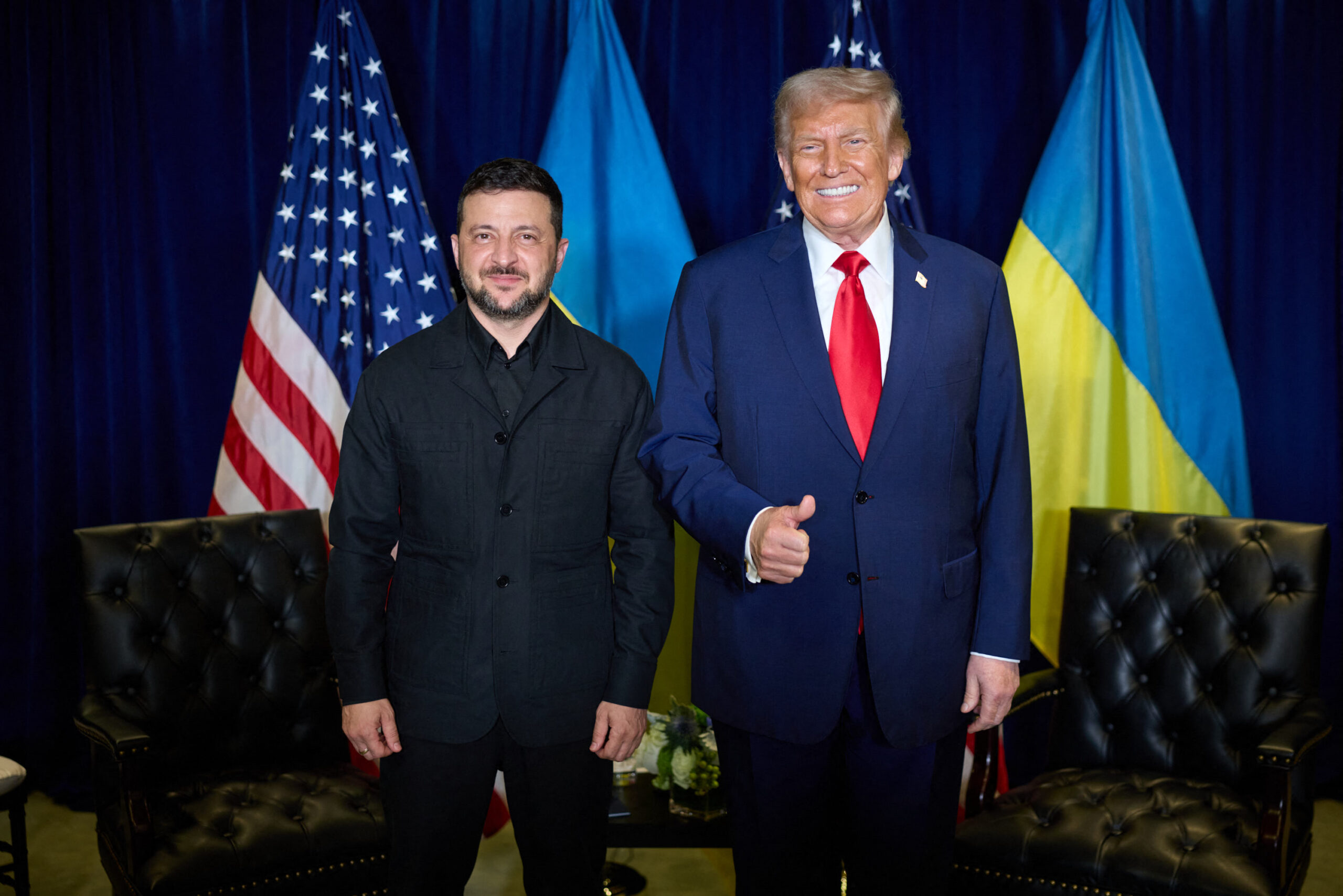
Handout - Ukrainian President Volodymyr Zelenskyy meets with U.S. President Donald Trump on the sidelines of the United Nations General Assembly in New York, on Tuesday, September 23, 2025. Photo via Ukrainian Presidential Press Office/ABACAPRESS.COM
The concept of a paper tiger is powerful in political discourse, evoking strong imagery while conveying the nuances of perceived strength versus actual capability. It is important to unpack this term further, especially in the context of international relations and domestic political landscapes.
Definition and Core Meaning
At its essence, a paper tiger represents a situation or entity that bears a façade of strength and intimidation yet lacks the substance to back it up. The term comes from the Chinese idiom zhǐlǎohǔ (纸老虎), which translates to “paper old tiger.” Here, the juxtaposition is clear: while a real tiger embodies might and ferocity, a paper tiger is delicate and defenseless. This concept particularly resonates in political dialogue, where appearances can often be misleading, giving rise to exaggerated perceptions of threat or power.
This term succinctly encapsulates the idea of something that may loom large in rhetoric and symbolism but crumbles when faced with genuine challenges. In political discourse, a paper tiger is typically a nation, political entity, or institution that, while boasting considerable influence or military prowess, ultimately fails to deliver on those perceived threats.
Origin and Historical Development
The modern usage of the phrase can largely be traced to Mao Zedong, who popularised it in the West. During a meeting with an American journalist in 1946, Mao characterised the United States as a paper tiger, particularly highlighting its support for the Chinese Nationalists and its failure to effectively challenge communist movements. In a subsequent 1956 interview, he elaborated on this characterization, painting a vivid picture of an outwardly powerful entity that was “unable to withstand the wind and the rain.”
The idiom was further enshrined in political discourse when it was included in Quotations from Chairman Mao Zedong (often referred to as The Little Red Book), which was published in 1964. However, it is important to note that the phrase predates Mao’s use; the idiom was part of Chinese sayings describing blustering entities long before it entered global vocabulary.
Political Usage and Applications
Cold War Era
The Cold War marked a notable period for the proliferation of the term. Both communist and Western blocs engaged in propagandistic back-and-forths, often labelling opponents as paper tigers. For example, U.S. media outlets frequently described the Soviet Union as a paper tiger, stemming from its vast military expenditures that masked an underlying fragility in its economic structures. Meanwhile, Soviet Premier Nikita Khrushchev famously retorted, asserting that “the paper tiger has nuclear teeth,” a remark that highlighted the complex dynamics of real versus perceived military threats during this tense era.
Contemporary Political Applications
The term continues to hold relevance in modern geopolitical discussions across various contexts. Below are key instances illustrating how the concept of a paper tiger has been wielded in recent politics:
-
Russia-Ukraine conflict (2025): Former President Donald Trump employed the term during a United Nations speech, implying that Russia’s military actions in Ukraine indicated a lack of real strength. He proposed that if Russia were genuinely powerful, the conflict would have been resolved swiftly. In response, President Vladimir Putin quipped, “If Russia is a paper tiger, then what is NATO, which cannot stop it?”
-
North Korea (2006): In the context of escalating tensions, then-Senator Joe Biden used the term to describe North Korea’s missile launches, arguing that despite their provocative actions, the nation lacked the capability to pose a direct threat to the United States.
-
U.S.-China trade relations: During the tumultuous trade war, Chinese netizens turned the phrase against Trump, portraying him as a paper tiger given the dependence of the U.S. economy on Chinese goods for basic necessities.
-
Domestic politics: The term also finds application in analysing domestic political frameworks, often being applied to regulations or policies that are perceived as ineffective or lacking robust enforcement mechanisms.
Legal Framework and UK Context
In the United Kingdom, there is no formal legal structure specifically governing the term paper tiger. Unlike legally defined concepts with regulatory oversight, the phrase functions within a broader rhetorical landscape, employed freely within journalism, political discourse, and public commentary. This absence of a formal legal framework highlights its role as a descriptive device rather than a regulated concept.
Responsible Authorities and Current Rules
There are no governmental or regulatory authorities tasked with defining or governing the term paper tiger. It is primarily utilised in political dialogue without binding formal definitions. Thus, its interpretation can vary widely depending on the context in which it is used, making it an adaptable tool in political rhetoric.
Recent Changes and Risks
The recent resurgence of the term in geopolitical discussions has significant implications. Particularly in high-stakes scenarios such as the Ukraine conflict, tensions in the Taiwan Strait, and U.S.-Russia relations, the use of “paper tiger” rhetoric can exacerbate existing tensions rather than foster constructive dialogue. The term, used dismissively, risks trivialising real threats and capabilities, potentially leading to miscalculations in international disputes.
Furthermore, the weaponisation of this term adds an antagonistic flavour to diplomatic communication, which may inhibit resolution and exacerbate conflict. As noted by analysts, when political discourse shifts toward portraying adversaries in such simplistic terms, the likelihood of escalation increases, leaving no room for nuanced understanding.
Practical Implications
Utilising the term paper tiger in political and strategic contexts carries several implications. By characterising an opponent as a paper tiger, the user aims to delegitimise their perceived power and consolidate domestic support for a particular policy or stance. While this can unite constituents behind national narratives, it may also risk provoking aggressive responses from those thus characterised.
However, the accuracy of these assessments is often contingent on evolving circumstances. The effectiveness of using the term hinges greatly on real-world events that validate or contradict such characterisations. For example, misassessing an adversary’s capabilities can lead to compounding errors in judgement, while historically some applications of the term have revealed a cold reality behind its initial premises.
To illustrate this impact, consider a practical example: during the 1950s, U.S. politicians often referred to the Soviet Union as a paper tiger, downplaying its military capabilities. This miscalculation potentially influenced foreign policy decisions, leading to strategic overconfidence in various military engagements.
The terminology’s elasticity allows for a wide application across contexts and scenarios, but it comes at a cost. If political leaders misjudge the actual strength of those labelled as paper tigers, it could lead to undesired conflict rather than maintain smooth diplomatic relations.
In summary, the term paper tiger, both in historical and contemporary contexts, serves as an evocative rhetorical device that encapsulates the dichotomy of perceived power versus genuine capability. Its implications stretch across international relations, domestic politics, and military strategy, making it a significant phrase within the political lexicon that warrants careful and judicious usage. As with all powerful language, the potential consequences of its application can shape narratives, influence perceptions, and, ultimately, dictate actions on the geopolitical stage.
For further insights into how Ukraine is navigating its political landscape, check out the exploration of Understanding Kano Politics: Key Insights into Governance and Electoral Structures in Nigeria (https://www.mypoliticalhub.com/2026/01/01/kano-politics-electoral-system/), which delves into the dynamics of political power within different contexts.
About The Author