Sophie Gesture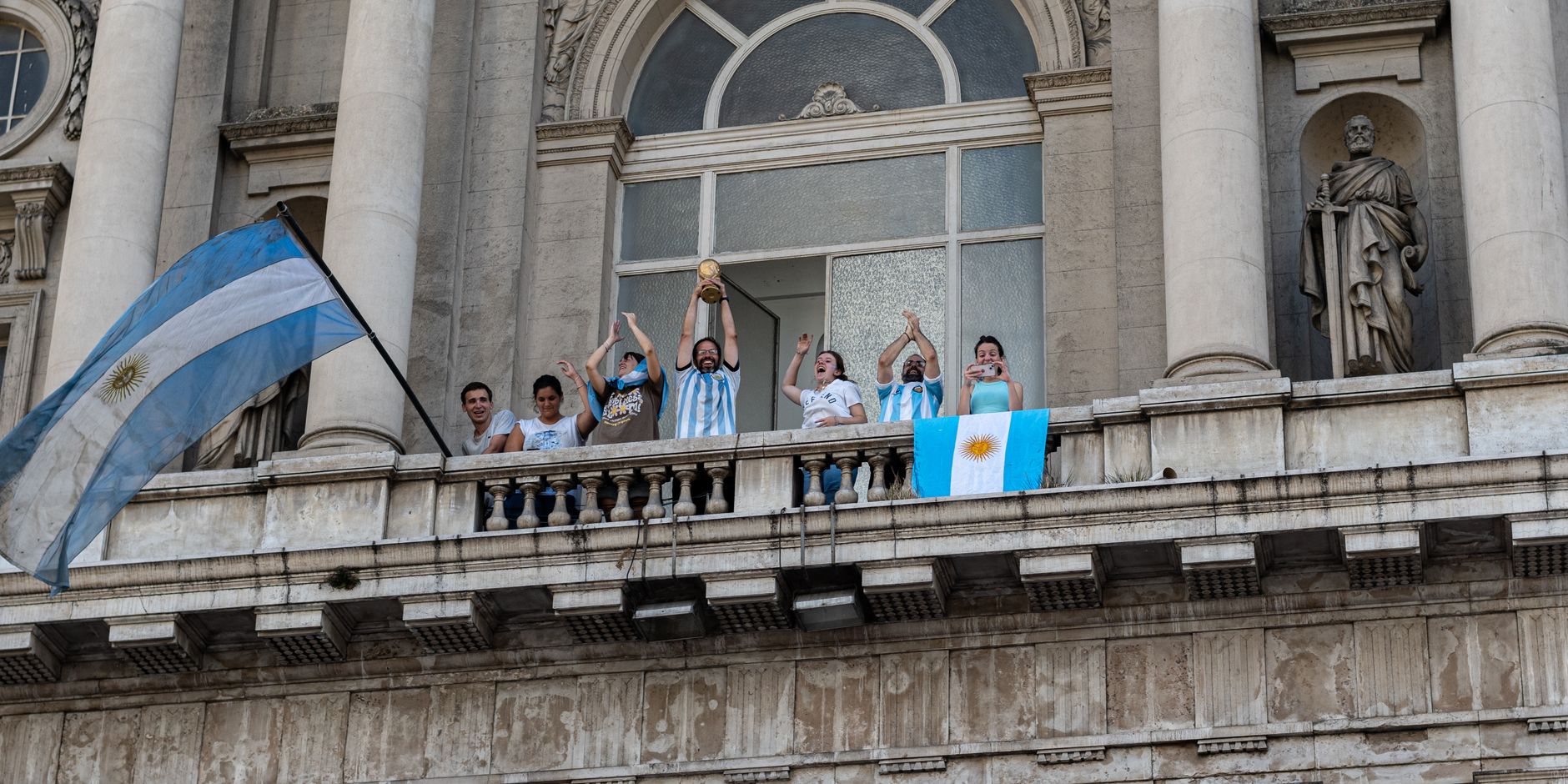
Five billion dollars in projected U.S. economic impact. Forty-eight nations. Sixteen host cities spread across three countries. And a sitting president who has spent his entire political career telling certain people — many of them from the nations whose players will electrify those stadiums — that they do not belong here.
That is the central, unresolvable tension of World Cup 2026. Not the group stage draws. Not the expanded format debates. The real drama is this: the world’s most global sporting event is about to unfold inside one of the most aggressively nationalist political administrations in modern American history, and almost everyone involved — FIFA, corporate sponsors, national federations — is betting they can pretend those two things exist in separate universes. They cannot.
How the World Cup Became the Last Arena Where Tribal Nationalism Gets a Standing Ovation
There is a word for what happens every four years when billions of people paint their faces, drape themselves in flags, and chant their country’s name with a ferocity they would never display in any other public setting. Political scientist Michael Billig called it “banal nationalism” — the everyday, unreflective invocation of national identity that sporting events supercharge into something far more visceral and tribal. In 1995, when Billig coined the term, he was describing the mundane nationalism of flagpoles and postage stamps. The World Cup turns it into something closer to a fever.
Here is what makes 2026 historically distinct from every prior tournament: we now live in a political moment where nationalism in its explicit political form — Brexit, Trumpism, ethno-nationalist parties surging across Europe — is routinely described by liberal commentators as a civilizational threat. Yet those same commentators will spend 39 days this summer screaming “USA! USA!” at MetLife Stadium without a trace of irony. The World Cup is the one remaining space where overt, unambiguous flag-waving nationalism is not only tolerated but commercially packaged and sold back to you at $15 a beer.
That paradox did not begin in 2026. It has a long, deeply political history. The World Cup’s colonial subtext runs back decades — from the 1934 tournament Mussolini weaponized for fascist legitimacy, to the 1978 Argentina edition hosted by a military junta while dissidents disappeared into the Rio de la Plata, to Qatar 2022, where an estimated 6,500 migrant workers died building the very stadiums where the world celebrated the “beautiful game.”
| World Cup | Host Political Context | Dominant Controversy | Outcome for FIFA |
|---|---|---|---|
| 1934 Italy | Mussolini’s fascist regime | Tournament used as propaganda tool | FIFA silent; tournament proceeded |
| 1978 Argentina | Military junta; ongoing disappearances | Protests ignored; junta legitimized | Record TV audiences; FIFA profits |
| 2018 Russia | Putin era; Ukraine annexation ongoing | Western discomfort; no boycott | $6.1B revenue; Russia rehabilitated |
| 2022 Qatar | Autocratic state; migrant labor deaths | 6,500 worker deaths; LGBTQ+ bans | $7.5B revenue; record viewership |
| 2026 USA/Canada/Mexico | Trump immigration crackdowns; trade wars with co-hosts | Fan safety fears; deportation risks | Projected $11B+ revenue |
The pattern is unmistakable. FIFA has never once allowed political reality to interrupt its revenue cycle. Why would 2026 be different?
Trump, ICE, and Mexican Fans: The Fan Safety Crisis Fracturing the 2026 Tournament Right Now
Donald Trump did something remarkable in early 2025. He simultaneously took credit for securing the United States’ co-hosting rights — citing his personal friendship with FIFA President Gianni Infantino — and accelerated the most aggressive immigration enforcement regime in modern U.S. history. Those two things are now on a direct collision course, and the collision is happening in real time.
Here is the timeline of how the fan safety crisis developed:
- June 2018: The United 2026 bid — United States, Canada, Mexico — officially wins the right to host. The bid promises an inclusive, globally welcoming tournament.
- January 2025: Trump’s first-term executive orders on immigration are reissued and expanded. Sweeping enforcement actions begin targeting Latin American migrants across major U.S. cities — including Dallas, Los Angeles, and New York, three of the eleven U.S. host cities.
- January 2025: Amnesty International publishes a formal letter to FIFA demanding written, legally enforceable guarantees of safe passage for all fans regardless of nationality or immigration status.
- February 2025: The Mexican Football Federation (FMF) issues a formal statement expressing “serious concerns” about whether Mexican fans traveling to U.S. host cities would face ICE enforcement actions.
- March 2025: FIFA and the U.S. State Department issue a joint statement affirming that World Cup visa holders would be exempt from standard immigration enforcement protocols. Civil liberties organizations immediately call the statement “unenforceable and legally meaningless.”
- June 11, 2026: The tournament opens at MetLife Stadium in New Jersey. Every television camera in the world is pointed at a country simultaneously celebrating global unity and conducting mass deportation operations.
The specific concerns being raised by civil society groups include:
- Undocumented migrants from participating nations who have lived in the U.S. for years, potentially attending matches and becoming visible to enforcement agencies
- Muslim fans from nations affected by Trump’s travel restriction executive orders facing visa denials or enhanced screening
- LGBTQ+ fans from accepting nations traveling to a U.S. political environment that has significantly curtailed LGBTQ+ protections at the federal level
- Players and team officials from nations with strained diplomatic relations with the Trump administration facing bureaucratic obstacles
None of this is hypothetical. It is the operational reality of hosting the world inside a country that has made hostility to outsiders its governing philosophy. For more on the geopolitical tensions shaping sport and politics simultaneously, our worldwide political news coverage tracks these intersections continuously.
Trump, Infantino, and Zirin: Three Men Defining What World Cup 2026 Actually Means
Donald Trump
Trump has claimed personal ownership of World Cup 2026 in a way no prior U.S. president claimed any sporting event. He has publicly stated that his relationship with Infantino was decisive in securing the hosting rights, a claim that is difficult to verify but impossible to dismiss entirely given the timeline — the bid was finalized in June 2018, during Trump’s first term. What is verifiable is the contradiction Trump embodies for this tournament. He is simultaneously its most prominent domestic champion and its most serious structural threat. Every ICE raid in Los Angeles between now and July 19, 2026 is a story about the World Cup host nation. Every deportation flight landing in Mexico City is political context for a tournament Mexico is co-hosting. Trump does not see the contradiction. That is precisely what makes him dangerous to FIFA’s apolitical brand.
Gianni Infantino
Infantino has perfected a very specific form of diplomatic cowardice. He maintains studious public silence on U.S. immigration policy while privately securing administrative assurances — assurances that Amnesty International has correctly identified as unenforceable. His close personal friendship with Trump, documented in multiple press accounts from early 2025, has become a genuine reputational liability. FIFA under Infantino secured $7.5 billion from Qatar 2022 while workers died building the stadiums. The financial logic of 2026 is identical: projected revenue exceeds $11 billion, and no human rights concern has ever caused FIFA to walk away from that kind of money. Infantino’s calculation is cold, consistent, and entirely predictable.
Dave Zirin
Dave Zirin, sports editor of The Nation and author of Brazil’s Dance with the Devil (2014), has done more than any other American journalist to name what the World Cup actually is beneath the spectacle. His central argument — articulated in his widely read piece “Beyond the Scoreboard” — is that FIFA tournaments function as engines of political laundering, wrapping authoritarian governance, corporate extraction, and nationalist violence in the warm glow of athletic competition. Zirin draws an explicit line from Argentina 1978 to Qatar 2022 to the United States in 2026. His critique is not that sport is inherently political. It is that sport’s claim to transcend politics is itself the most political thing about it — a claim that consistently benefits the powerful and costs the vulnerable.
Why FIFA, the U.S. Government, and the Progressive Critics Are All Getting This Wrong
Let’s be direct about something. Three distinct groups are failing to reckon honestly with what World Cup 2026 actually represents.
FIFA insists the tournament is apolitical. This is not naivety. It is a business strategy. An organization that generated $7.5 billion from Qatar 2022 — a tournament built on migrant labor deaths — does not accidentally fail to engage with human rights concerns. It strategically insulates its brand from those concerns by claiming sport sits above politics. This fiction serves FIFA’s sponsors, its broadcast partners, and its Swiss-based executive structure, none of whom benefit from the tournament becoming a referendum on immigration enforcement.
The Trump administration frames the World Cup as a national triumph — proof of America’s irresistible global appeal. This conveniently ignores that the tournament’s draw relies precisely on the multicultural, immigrant-descended communities that Trump’s policies most directly target. The players who will fill U.S. stadiums with atmosphere are disproportionately the sons and grandsons of the migrants Trump’s base wants removed. The fans who will spend the most in American host cities are frequently from the nations Trump has imposed tariffs on and insulted publicly. The economic windfall Trump is claiming credit for depends entirely on a cosmopolitan global mobility his domestic politics actively undermines.
Some progressive critics have the diagnosis right but overcorrect into a purity trap that ignores real complexity. The argument that the World Cup should be boycotted, or that fans who attend are complicit in Trump’s immigration policies, misunderstands what the tournament means to the billions of people — many of them poor, many of them from the Global South — for whom national football is one of the few arenas where they see their country represented with dignity on a world stage. Telling a Senegalese fan that watching his nation compete in the round of 16 is an act of political capitulation is a form of condescension masquerading as radicalism.
The actual honest position is the uncomfortable one: the World Cup is simultaneously a genuine expression of popular joy and a machine for political exploitation. Both things are true. Pretending only one is true — whether you’re FIFA or a sports journalist from Brooklyn — is its own form of dishonesty.
Four Scenarios That Will Determine Whether World Cup 2026 Breaks the Apolitical Sports Spectacle for Good
The question is not whether politics will enter the 2026 World Cup. It already has. The question is whether a specific, visible incident forces the fiction of sporting neutrality to collapse publicly in a way that cannot be managed or spun.
- Scenario 1 — The ICE Incident: A foreign national, in the United States on a legitimate World Cup visa, is detained or questioned by immigration enforcement in or near a host city. This scenario has a non-trivial probability given the scale of enforcement operations underway. If it happens, it becomes the dominant global story within hours — and FIFA’s joint statement with the State Department becomes evidence of institutional bad faith rather than a protective guarantee.
- Scenario 2 — The Player Protest: One or more high-profile players — from a major footballing nation with global media attention — kneel, display an armband, or make a public statement connecting their performance to U.S. immigration policy or their community’s experience. FIFA’s rules on political expression during matches are strict but selectively enforced. The attempt to sanction a protest gesture from a player whose national fanbase includes millions of U.S.-based immigrants would be a global media catastrophe.
- Scenario 3 — The Diplomatic Boycott: A nation — most plausibly one with deteriorated U.S. diplomatic relations, or one whose fan base faces specific travel barriers — announces it will not send fans or declines to participate in certain ceremonial aspects of the tournament. A targeted boycott short of full withdrawal is the most politically precise tool available.
- Scenario 4 — The Commercial Insulation: Nothing catastrophic happens. The games are spectacular. The U.S. team goes deep into the knockout rounds. Television ratings break records. Sponsors report the highest ROI in World Cup history. The $11 billion revenue projection is exceeded. And everyone — FIFA, Trump, corporate partners — points to this outcome as proof that sport can and does transcend politics. This is, historically, the most likely scenario. It is also the most politically dangerous one.
| Scenario | Probability | Impact on FIFA Brand | Impact on Trump Politically | Impact on Future Host Decisions |
|---|---|---|---|---|
| ICE Incident | Medium | Severe short-term damage | Mixed — base rallies, moderates alarmed | Forces enforceable fan safety protocols |
| Player Protest | Medium-High | Moderate — precedent from Qatar | Weaponized domestically | Tighter expression rules debated |
| Diplomatic Boycott | Low-Medium | Minimal if small nation; severe if major | Framed as anti-American by White House | Accelerates geopolitical bidding wars |
| Commercial Insulation | High | Reinforced; model validated | Major political win claimed | Emboldens future controversial host bids |
The most troubling aspect of Scenario 4 is not that it represents failure. It is that it represents the system working exactly as designed — and the design prioritizes revenue over every other consideration without exception.
The World Cup has always been nationalism wearing a party hat. What makes 2026 different is that the host nation’s government has made nationalism not a party but a weapon — deployed against specific people, specific communities, specific bodies crossing specific borders. The question worth sitting with between now and July 19, 2026 is not whether you’ll watch. You will. Most of the world will. The question is whether you can watch honestly — knowing exactly what machinery you’re feeding — and whether that honesty changes anything at all. History suggests it won’t. But history has occasionally been wrong.
About The Author